
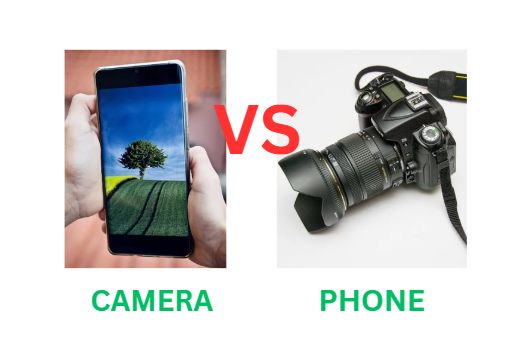
Phone vs Camera: The Ultimate Deep Dive (2026 Guide).
In this deep‑dive guide, we’ll break down the technical and practical differences between phone vs camera, explore real‑world scenarios, and help you decide which tool truly belongs in your gear bag.
Every traveler, content creator, and casual shooter eventually faces the same question: Do I really need a dedicated camera, or is my smartphone good enough?
In one corner, we have the smartphone: always in your pocket, computationally enhanced, and capable of stunning results in good light.
In the other corner, the dedicated camera: larger sensors, interchangeable lenses, and manual controls that put you in the driver’s seat.
This isn’t a simple “which is better” debate because the answer depends entirely on what you shoot, where you shoot it and how you plan to use the final image, let me break everything down on the difference between a phone vs camera debate.
1. The Sensor Size Gap: Why Physics Still Matters.
At the heart of every digital camera lies an image sensor. Its size is arguably the single most important factor affecting image quality.
Smartphone Sensors.
Most flagship smartphones (iPhone 16 Pro, Samsung Galaxy S25 Ultra, Google Pixel 9 Pro) use sensors roughly 1/1.3‑inch to 1‑inch in size. That’s tiny about the size of a pinky fingernail.
Dedicated Camera Sensors.
- 1‑inch sensor (premium compacts): Already larger than almost any phone.
- Micro Four Thirds: Roughly 2x the area of a 1‑inch sensor.
- APS‑C (entry‑to‑mid‑range mirrorless): About 3–4x larger than a phone sensor.
- Full‑frame (professional mirrorless/DSLR): Up to 7x larger than a phone sensor.
Why size matters: A larger sensor captures more total light. More light means less noise, better dynamic range, and richer colors especially in low light, shadows, and high‑contrast scenes. You can print larger, crop more aggressively, and retain detail that a phone simply cannot match.
Verdict: For pure image quality in challenging conditions, a dedicated camera wins every time.
2. Lenses: Optical Zoom vs. Digital Crop – Phone Vs Camera.
The Phone’s Multi‑Lens Array.
Most modern phones have three or four fixed focal length lenses:
- Ultra‑wide (≈0.5x)
- Main wide (≈1x, 24‑28mm equivalent)
- Telephoto (≈2x–5x, 50–120mm equivalent)
Zooming between these lenses is optically true magnification without quality loss. But zooming beyond the longest lens is digital zoom, which is essentially cropping the image inside the sensor. Result: massive loss of detail and increased noise.
The Camera’s Optical Zoom.
A dedicated camera with an interchangeable lens (or a high‑end compact with a zoom lens) can zoom continuously across a range, say 24‑200 mm, with pure optical magnification. Every millimeter is true glass, not a software crop.
Furthermore, you can attach specialty lenses: ultra‑wide zooms, fast primes (f/1.4), super‑telephotos (400mm+), and macro lenses. No phone can match that versatility.
Verdict: If you shoot wildlife, sports, or any distant subject, a camera with optical zoom is non‑negotiable.
3. Computational Photography: The Phone’s Secret Weapon.
Phones can’t beat physics, but they can simulate better results through computational photography.
- HDR merging: Your phone takes multiple exposures in milliseconds and blends them for perfect highlights and shadows.
- Night mode: It stacks many long‑exposure frames to brighten a dark scene without a tripod.
- Portrait mode: AI separates your subject from the background to add fake bokeh (blur).
- Deep Fusion / Smart HDR: Pixel‑level processing that optimizes texture, noise, and color.
Phone Vs Camera – Cameras Are Catching Up.
Many modern mirrorless cameras (Sony, Canon, Nikon, Fujifilm) now include built‑in HDR, focus stacking, and even hand‑held high resolution modes. But they still rely primarily on optical quality, not algorithmic trickery.
The catch: Computational photography can look unnatural over‑sharpened, waxy skin, or halos around edges. A camera’s raw file, by contrast, is a honest starting point that you can edit to taste.
Verdict: For point‑and‑shoot ease in good light, the phone is unbeatable. For natural, editable files, choose a camera.
4. Low Light and Dynamic Range: Where Cameras Pull Ahead.
Take the same scene at dusk a city skyline with bright windows and dark alleys.
- Phone: Will likely produce a surprisingly bright, detailed image thanks to night mode. But look closely: noise in shadows, smeared fine details, and sometimes unnatural colors.
- Camera (APS‑C or full‑frame): With a fast lens (f/1.8 or f/2.8) and a tripod (or high ISO), you get clean shadows, accurate colors, and sharp details that can be printed large.
Dynamic range (the ability to capture details in both bright highlights and deep shadows) is also significantly better on larger sensors. A modern full‑frame camera can capture 14–15 stops of dynamic range; a phone, even with computational tricks, struggles to reach 10–11 true stops.
Verdict: For evening cityscapes, indoor events, concerts, and astrophotography, a dedicated camera is vastly superior.
5. Portability and Convenience: The Phone’s Ace.
Your phone is already in your pocket. It’s with you at breakfast, on the subway, during a spontaneous sunset. A dedicated camera requires forethought: you must pack it, carry it, and often manage extra lenses and batteries.
For everyday memories, travel snaps, street photography (where discretion matters), and social media content, the convenience factor alone makes the phone the right choice for millions of people.
Verdict: The best camera is the one you have with you. For most casual situations, that’s your phone.
6. Video Capabilities: A Surprising Battleground.
Flagship phones now shoot 8K video, with incredible stabilization (action mode), HDR (Dolby Vision), and even LOG profiles (iPhone 15 Pro and later). For vloggers and TikTok creators, a phone can be a complete production studio and hikers best for hiking vlogs.
Where cameras still lead:
- Overheating: Phones often overheat during extended 4K/8K recording; mirrorless cameras with heat sinks can record for hours.
- Audio: XLR inputs, shotgun mics, and proper preamps give cameras professional sound.
- Lens versatility: For cinematic shots, nothing beats a fast prime or a zoom with parfocal design.
- Codecs and bitrates: Cameras offer All‑Intra, ProRes, and RAW video with much higher data rates for grading.
Verdict: For short clips, social media, and run‑and‑gun vlogging, a phone is excellent. For long‑form, professional, or cinematic projects, a camera wins.
7. Workflow and Editing: Straight Out of Camera vs. Post‑Processing.
Phone Workflow.
- AI processing happens instantly.
- Photos are ready to share directly from the camera roll.
- Editing apps (Lightroom Mobile, Snapseed) are powerful but limited compared to desktop.
Camera Workflow.
- Requires transferring files (SD card to computer or phone).
- RAW files demand post‑processing to unlock their full potential.
- But that process gives you complete creative control white balance, sharpening, noise reduction, and grading.
Verdict: If you want “good enough” with zero fuss, use a phone. If you enjoy editing and want to make art, a camera is more rewarding.
8. Cost Considerations: Upfront vs. Long‑Term Investment.
| Device | Typical Cost | Longevity |
| Flagship phone | 800–800–1,600 | Upgraded every 2–4 years |
| Entry‑level mirrorless | 500–500–1,000 (body + kit lens) | 5–10+ years |
| Premium compact (1″) | 700–700–1,200 | 5+ years |
| Full‑frame camera + lens | 2,000–2,000–6,000+ | 10+ years |
A phone does double duty (calls, apps, GPS), so its cost is harder to attribute solely to photography. But over time, a good camera and a couple of lenses can outlast several phone upgrades.
Verdict: For occasional shooters, a phone is more economical. For serious enthusiasts, a camera pays off in image quality and longevity.
9. Who Should Buy a Camera? (And Who Can Stick With a Phone).
You’re happy with just a phone if…
- You mainly share photos on social media or view them on a phone/tablet.
- You don’t print larger than 8×10 inches.
- You rarely shoot in very low light or at extreme distances.
- You prioritize convenience and don’t want to carry extra gear.
You should buy a dedicated camera if…
- You want to print large (16×20 or bigger) or sell your images.
- You shoot wildlife, sports, or any distant subject requiring long telephoto lenses.
- You love shooting at night, astrophotography, or indoor events without flash.
- You enjoy the creative control of manual settings and post‑processing.
- You need professional video features (unlimited record time, XLR audio, etc.).
10. Phone vs Camera: Head‑to‑Head Comparison Table.
| Feature | Smartphone (Flagship) | Dedicated Camera (Mirrorless/DSLR) |
| Sensor size | Very small (1/1.3″ to 1″) | Large (1″ to full‑frame) |
| Lens flexibility | Fixed multi‑lens; digital zoom beyond | Interchangeable or true optical zoom |
| Low‑light performance | Good (computational) but noisy | Excellent (large sensor + fast lens) |
| Dynamic range | Limited (8–10 stops) | Wide (12–15 stops) |
| Portability | Always in pocket | Requires bag or strap |
| Battery life | 1 day (heavy use) | 300–1000+ shots per charge |
| Video recording limit | Often 15–30 min (overheating) | Unlimited (with proper cooling) |
| Audio input | Usually no external mic jack* | 3.5mm, XLR, or wireless |
| Workflow | Instant sharing, minimal editing | Requires transfer, often RAW editing |
| Cost over 5 years | 1,600–1,600–3,200 (multiple upgrades) | 800–800–2,500 (body + lenses, one‑time) |
Some phones (iPhone, high‑end Android) support USB‑C external mics.
11. Conclusion.
The phone vs camera debate isn’t about which is “better”; it’s about which is right for you. Your smartphone is an incredible, convenient tool that has democratized photography and video. For most everyday moments, social sharing, and even some professional applications, it’s more than enough.
But when you need optical zoom, true low‑light performance, creative control, or the ability to print large, a dedicated camera still holds an unassailable lead. The good news is you don’t have to choose one forever. Many photographers use both: a phone for daily snapshots and a camera for planned shoots, trips, and serious work.
My advice: Start with your phone. Learn its limits. When you find yourself frustrated by those limits, rent or borrow a camera. You’ll quickly know which side of the fence you belong on.
12. Frequently Asked Questions (FAQs).
Can a phone ever match a camera’s image quality?
Not physically. But computational photography can make the gap nearly invisible in good light and for small screen viewing. For large prints or professional use, the camera remains superior.
Do professional photographers ever use phones?
Yes, for behind‑the‑scenes, quick social media posts, or specific projects (e.g., Apple’s “Shot on iPhone” campaigns). But for paid client work (weddings, commercial, wildlife), they rely on dedicated cameras.
Is a 1‑inch sensor camera better than a phone?
Absolutely. A premium compact with a 1‑inch sensor (like the Sony RX100 series or Canon G7 X Mark III) will out‑perform any phone in low light, dynamic range, and optical zoom.
What’s the best camera for someone upgrading from a phone?
A used APS‑C mirrorless camera (Sony a6000 series, Fujifilm X‑T20, Canon R50) with a fast prime lens (e.g., 35mm f/1.8) will be a revelation.
How important is RAW vs. JPEG on a camera vs phone?
Phones often shoot “computational RAW” (e.g., Apple ProRAW, Samsung Expert RAW), which retains some processing but gives more editing flexibility. A camera’s RAW file is truly unprocessed, offering the most latitude.
Will AI make cameras obsolete?
Unlikely. AI can enhance images, but it cannot replace the physics of light gathering. Cameras will continue to incorporate AI (subject detection, autofocus), but the sensor size advantage remains.
Is it worth buying a camera for travel if I’m not a pro?
Yes, if you value image quality and want to print or share high‑resolution photos. But for casual travel, a flagship phone is often sufficient.
Disclaimer: This article is for informational purposes only. Product specifications and prices are subject to change. Always check current details with official manufacturers and retailers before purchasing.
